Encyclopedia of Synchronicity
Are Angel Numbers Real or Apophenia? What Psychology Says
No scientific evidence backs angel numbers as signs. Apophenia, selective attention and confirmation bias explain why repeating numbers feel meaningful.
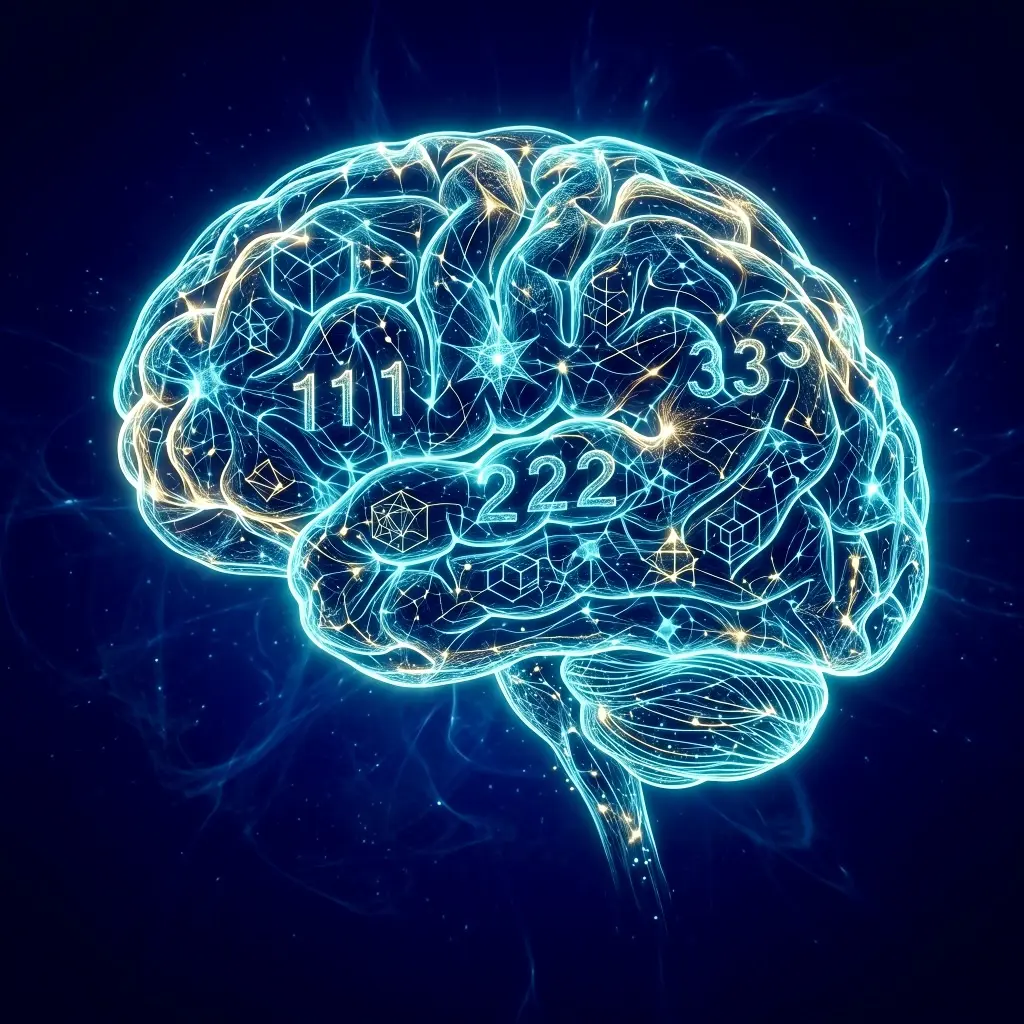
Are Angel Numbers Just Apophenia?
Short answer: Apophenia is the brain’s tendency to see meaningful patterns in random data. It largely explains angel numbers: once 11:11 or 222 matters to you, selective attention, the frequency illusion and confirmation bias can make it seem to appear everywhere. There is no reliable evidence that repeated numbers are external messages or predictions, but they can still work as honest prompts for self-reflection.
Seeing 11:11, 222, 333, 444 or the same number sequence again and again can feel surprisingly meaningful. Maybe it appears on a clock, a receipt, a license plate, a notification or right when you are thinking about someone, a decision or a difficult moment in your life.
Psychology has a useful word for part of this experience: apophenia.
Apophenia is the mind’s tendency to find patterns, connections or meaning in random, ambiguous or unrelated data. In simple terms, it is what happens when your brain connects dots and turns coincidence into a story.
That does not mean you are “making everything up.” It means your brain is actively involved in meaning-making. It notices some patterns, remembers some coincidences and gives them more weight when they connect with something emotionally important.
Interpretive content: this guide offers a psychological and practical explanation of apophenia, angel numbers and repeated-number experiences. It is not a substitute for medical, psychological, legal or financial advice.
Quick answer: what is apophenia?
Apophenia is the human tendency to perceive meaningful patterns or connections in information that may be random, ambiguous or unrelated.
It can happen when you:
- see 11:11 right when you are thinking about someone;
- notice 222 several times during an emotional period;
- find 333 on receipts, clocks and license plates;
- connect a date with an important event;
- hear a song that seems to answer what you were feeling;
- interpret coincidences as signs.
Your mind does not treat all information equally. It filters, selects and remembers what feels relevant. That is why a coincidence can feel powerful even when it also has a psychological explanation.
A balanced way to understand it is this:
The experience can feel meaningful, but that does not automatically make it external proof, a prediction or a command.
What you will learn in this guide
- What apophenia means in psychology.
- Why you keep seeing angel numbers like 11:11, 222 or 333.
- How apophenia connects with angel-number experiences.
- The difference between apophenia, pareidolia and synchronicity.
- How selective attention, the frequency illusion and confirmation bias work.
- Why repeated numbers feel especially meaningful during emotional moments.
- When signs can support reflection and when they can increase anxiety.
- How to use recurring numbers in a grounded and healthy way.
Apophenia and angel numbers
Angel numbers are usually described as repeated number sequences that carry spiritual or symbolic meaning: 111, 222, 333, 444, 1111 or mirror-hour patterns like 11:11 and 22:22.
From a spiritual perspective, many people experience them as signs of guidance, protection, alignment, love, change or awakening. From a psychological perspective, part of that experience can be explained through apophenia: the brain notices a striking sequence and connects it with an internal state, a question or an emotional need.
This does not have to become a battle between science and spirituality.
A more useful view is:
- Psychologically, your mind detects patterns and gives them meaning.
- Symbolically, those patterns can become personal reminders.
- Practically, what matters is how you use the experience: for reflection or for dependence.
The problem is not feeling that a number is meaningful.
The problem begins when the number starts making decisions for you.
Why repeated numbers stand out
Repeated numbers are easy for the brain to notice because they look ordered. Sequences like 11:11, 22:22, 333 or 444 stand out more than irregular combinations like 13:47 or 628.
The human brain quickly detects:
- repetition;
- symmetry;
- visual order;
- simple patterns;
- memorable sequences;
- emotionally charged coincidences.
That is one reason a time like 11:11 can feel more special than other times. It is not only because of its spiritual interpretation. It is also visually memorable.
If it appears during an emotional moment — a breakup, a decision, a hope, a fear, a transition — the impact becomes stronger.
The number is no longer just data.
It becomes a symbol.
Selective attention: when your mind starts looking for the pattern
Selective attention is the mind’s ability to filter the enormous amount of information around you and highlight what seems relevant.
If you see 11:11 one day and it affects you, your brain may begin to detect it more easily after that. Not necessarily because the world changed, but because your attention changed.
Before, you may have checked the clock at 11:11 without remembering it. Now your mind marks it as important.
This happens in many ordinary situations:
- you learn a new word and suddenly see it everywhere;
- you buy a car and start noticing the same model on the road;
- you hear a name and it seems to appear constantly;
- you connect a number with a life event and start detecting it more often.
Angel numbers can work in a similar way. Once a sequence becomes meaningful, your attention gives it priority.
Frequency illusion: why it feels like angel numbers are everywhere
The frequency illusion, also known as the Baader-Meinhof phenomenon, happens when something you recently noticed or learned suddenly seems to appear everywhere.
It does not always mean the thing is appearing more often. Often, it means you are noticing it more.
With repeated numbers, the process can look like this:
- you see a number and it catches your attention;
- you search for its meaning;
- you give it emotional or symbolic weight;
- your mind starts detecting it more easily;
- each new appearance reinforces the feeling of a sign.
That is why you might think:
“Ever since I searched what 111 means, I keep seeing it everywhere.”
Your experience can be real: you really are noticing it. But the explanation may be that your attention has become tuned to that pattern.
Confirmation bias: remembering what fits the story
Confirmation bias is the tendency to notice and remember information that supports what you already believe or expect.
If you believe 11:11 appears when someone is thinking about you, you may strongly remember the times you saw 11:11 while thinking about that person. But you may forget:
- the times you thought about them and did not see 11:11;
- the times you saw 11:11 without thinking about anyone;
- the many ordinary times you checked the clock and nothing stood out;
- the coincidences that did not match the story.
The mind does not do this to deceive you. It does it because it tries to organize the world and reduce uncertainty.
During emotional periods, this bias can become stronger.
The heart wants answers, and the brain starts looking for signs.
Pareidolia: seeing images where there are none
Pareidolia is a specific form of apophenia. It happens when you see recognizable shapes in ambiguous visual stimuli.
Common examples include:
- seeing faces in clouds;
- seeing figures in wall stains;
- recognizing a face on the front of a car;
- seeing symbols in shadows or textures.
The difference is simple:
| Concept | What it describes | Example |
|---|---|---|
| Apophenia | finding meaningful patterns or connections in ambiguous data | interpreting repeated numbers as messages |
| Pareidolia | seeing recognizable forms in ambiguous visual stimuli | seeing a face in a cloud |
| Frequency illusion | feeling that something appears more after you notice it | seeing 111 everywhere after searching for it |
| Confirmation bias | remembering more of what supports your belief | noticing only the appearances that feel like signs |
Angel numbers are more closely related to apophenia, selective attention and the frequency illusion than to pareidolia, although all of these mechanisms belong to the same human tendency: searching for meaning.
Synchronicity: when a coincidence feels meaningful
Synchronicity, a concept popularized by Carl Jung, is often used to describe coincidences that feel deeply meaningful even when there is no obvious causal connection.
Applied to repeating numbers, this creates a middle ground.
You may not be able to prove that 11:11 caused something or was sent from outside you. But you can still ask why it affected you at that exact moment.
The question changes.
Not only:
“What does this number mean?”
But also:
“Why did this number feel meaningful to me right now?”
That question can reveal useful information about your inner state:
- an emotion you have not fully acknowledged;
- a decision waiting for your attention;
- a relationship taking up mental space;
- a need for closure;
- a desire for change;
- a search for reassurance;
- a need to feel guided.
From this perspective, synchronicity does not need to be external proof in order to have value.
It can work as a mirror.
So, are angel numbers only apophenia?
The most honest answer is: angel-number experiences can often be explained partly through apophenia, but that does not necessarily reduce their personal meaning.
From a scientific point of view, there is no reliable evidence that repeated numbers predict events, confirm destiny or prove that a person is thinking about you. But from a subjective point of view, a number can still have value as a symbol, reminder or reflection prompt.
The key is how you interpret it.
A rigid interpretation would be:
“I saw 11:11, so that person is thinking about me.”
A healthier interpretation would be:
“I saw 11:11 while thinking about that person. I can observe what emotion came up in me.”
A rigid interpretation would be:
“I saw 222, so everything will happen exactly as I want.”
A healthier interpretation would be:
“I saw 222, and I can use it as a reminder to look for balance, patience and clarity.”
The number can inspire you.
But it should not replace facts, conversations, decisions or personal responsibility.
Why angel numbers feel meaningful during emotional periods
Repeated numbers often feel most powerful when life is uncertain.
You may notice them more during:
- a breakup;
- a new relationship;
- grief;
- a career change;
- spiritual questioning;
- loneliness;
- major decisions;
- anxiety;
- hope for a sign;
- a need for reassurance.
In those moments, the mind naturally searches for order. A repeated number can become a small anchor: something clear, simple and memorable in the middle of emotional complexity.
That is why angel numbers can feel comforting.
They offer a sense of pattern when life feels unpredictable.
But comfort and proof are not the same thing.
A number can help you pause without proving what will happen next.
When a sign can help
A symbolic sign can be useful if it helps you:
- pause;
- breathe;
- observe your thoughts;
- write down what you feel;
- review a decision;
- look at a relationship more clearly;
- return to the present;
- act with more calm;
- recognize an internal need.
In this sense, repeated numbers can become personal reflection cues.
For example:
- seeing 111 may remind you to clarify what you are starting;
- seeing 222 may invite balance and patience;
- seeing 11:11 may work as a conscious pause;
- seeing 22:22 may help you review what you are building.
The value does not depend on the number commanding you.
It depends on how consciously you use the experience.
When it can become unhealthy
Your relationship with numbers can become unhealthy if it begins to create dependence or anxiety.
Warning signs include:
- checking the clock compulsively;
- feeling afraid when a number does not appear;
- making major decisions only because of a sign;
- interpreting every coincidence as destiny;
- justifying a harmful relationship because “the numbers confirm it”;
- searching for meanings again and again without feeling calmer;
- needing signs before texting, leaving, returning, buying, investing or deciding;
- feeling punished when you do not see the expected number.
A useful sign should return you to clarity.
If it takes away your peace, it may be time to step back.
This does not mean you need to mock or reject your experience. It means you need to recover your center.
How to use recurring numbers in a healthy way
The healthiest way to work with repeated numbers is to turn them into self-reflection prompts, not oracles.
When a number affects you, try this process:
- Pause. Do not search for the meaning immediately.
- Notice the context. Where were you? What were you doing?
- Name the emotion. Anxiety, hope, sadness, excitement, fear, calm?
- Ask what you need. Clarity, rest, conversation, boundaries, action, patience?
- Return to facts. What do you actually know?
- Choose a small action. Something grounded, not impulsive.
- Let go of certainty. Not every symbol needs a final answer.
A useful phrase is:
“I do not need to obey this number. I can use it to understand myself better.”
Journaling exercise: track repeated numbers without obsessing
If you often see repeated numbers, try keeping a simple log for one or two weeks.
Each time you notice a sequence like 11:11, 222, 333 or 444, write down:
| Question | Short answer |
|---|---|
| What number did I see? | 11:11, 222, 333… |
| Where did it appear? | clock, receipt, license plate, screen… |
| What was I thinking? | person, decision, fear, desire… |
| What emotion was present? | anxiety, calm, nostalgia, hope… |
| What interpretation came first? | sign, warning, confirmation… |
| What concrete facts do I have? | evidence, not assumptions |
| What small action can I take? | write, wait, speak, rest… |
After several days, review the pattern.
You may discover that certain numbers appear more often when:
- you are anxious;
- you think about someone;
- you are avoiding a decision;
- you need rest;
- you are looking for external reassurance;
- you are about to act impulsively.
That discovery can be more useful than any generic interpretation.
Apophenia, love and relationships
Apophenia can become stronger in love because emotion increases the need for meaning.
When a relationship is uncertain, someone pulls away, a breakup hurts or one person occupies a lot of mental space, the brain looks for signs that can reduce uncertainty.
That is why you may feel that:
- you see 11:11 when thinking about someone;
- songs connected to that person appear everywhere;
- their name comes up in random conversations;
- certain dates seem to repeat;
- a number seems to confirm they will come back.
But a coincidence does not replace facts.
In relationships, a healthy interpretation should include questions like:
- is there real reciprocity?
- does this person act consistently?
- do I feel peaceful or constantly waiting?
- am I using signs to avoid accepting reality?
- do I need a conversation, a boundary or closure?
Apophenia and spirituality: a more mature relationship
Understanding apophenia does not require you to erase spirituality.
It can make spirituality more mature.
Instead of thinking:
“If this number appears, something outside me has decided what I should do.”
You can think:
“If this number affects me, I can use it to observe what is moving inside me.”
That changes your relationship with the symbol.
You no longer need the number to be absolute proof. It can become a reminder, metaphor, journaling cue or invitation to listen to your inner state.
Spirituality becomes healthier when it does not deny psychology.
Psychology becomes more humane when it does not ridicule the need for meaning.
Psychological explanation vs symbolic meaning
These two levels can coexist.
| Level | Question | Example |
|---|---|---|
| Psychological | Why do I notice this pattern? | selective attention, frequency illusion, confirmation bias |
| Symbolic | What does it represent for me? | beginning, balance, love, closure, change |
| Practical | What do I do with this? | pause, journal, decide calmly, check facts |
The mistake happens when the levels get mixed.
It is not the same to say:
“This number reminds me that I need balance.”
As saying:
“This number proves everything will happen the way I want.”
The first can help you.
The second can make you dependent on signs.
Frequently asked questions about apophenia and angel numbers
What does apophenia mean in psychology?
Apophenia is the mind’s tendency to perceive meaningful patterns or connections in random, ambiguous or unrelated data. It can appear when people interpret repeated numbers, coincidences, dreams or symbols as personally significant.
Why do I keep seeing angel numbers everywhere?
Once a number becomes meaningful to you, your brain may start noticing it more through selective attention, the frequency illusion and confirmation bias. The number may not be appearing more often; you may simply be detecting and remembering it more.
Are angel numbers caused by apophenia?
Angel-number experiences can often be explained partly through apophenia and other cognitive biases. That does not mean the experience is fake or meaningless, but it does mean repeated numbers should not be treated as proof, predictions or external instructions.
Is there scientific evidence that angel numbers predict events?
There is no reliable scientific evidence that angel numbers predict events, confirm destiny or prove that someone is thinking about you. They can still have personal symbolic value, but they should not replace facts, decisions or professional advice when needed.
What is the difference between apophenia and pareidolia?
Pareidolia is a specific form of apophenia where the brain sees recognizable images, such as faces, in random visual stimuli. Apophenia is broader and includes patterns in numbers, coincidences, events and symbolic experiences.
What does 11:11 have to do with apophenia?
11:11 is visually memorable and emotionally easy to associate with meaning. If you already believe it is a sign, selective attention and confirmation bias can make it feel as if 11:11 appears at especially meaningful moments.
Does understanding cognitive bias ruin the meaning of angel numbers?
Not necessarily. Understanding cognitive bias can help you use repeated numbers more consciously, as prompts for reflection, without feeling controlled by them or treating them as absolute proof.
Does apophenia mean I am imagining things?
No. It means your mind is doing something human: searching for order and meaning. The issue is not noticing patterns, but turning them into rigid certainties that create anxiety or impulsive decisions.
When can seeing signs in numbers become unhealthy?
It can become unhealthy if it creates anxiety, compulsive checking, fear or major decisions based only on signs. If repeated numbers make you feel controlled or distressed, it may help to step back, focus on concrete facts and seek support if needed.
How can I use recurring numbers in a healthy way?
You can treat recurring numbers as mindfulness or journaling prompts. Ask what you were thinking, what emotion was present and what small grounded action you can take, instead of treating the number as an external command.
What should I do if repeated numbers make me anxious?
Reduce meaning-searching, avoid checking the clock on purpose and return to something concrete: breathing, journaling, talking to someone you trust or seeking professional support if anxiety becomes intense.
Next steps
If repeated numbers keep showing up in your life, you do not have to choose between believing everything and rejecting the whole experience. You can take a more useful position: understand how your mind builds meaning and use those patterns as moments of awareness.
To understand why a pattern suddenly seems to appear everywhere, read the guide on the frequency illusion and the Baader-Meinhof phenomenon. If your experience is connected to a specific mirror hour, you can explore the meaning of 11:11 or the meaning of 111.
Remember this: apophenia does not make your experience useless. It reminds you that meaning does not only appear outside you — it is also built inside you.
Sources and further reading
Related Articles
Frequency Illusion: The Baader-Meinhof Effect Explained
11:11 and Anxiety: Why Repeated Numbers Can Become Hard to Ignore
22:22 Psychology: Pattern Recognition, Attention and Why It Feels Significant
11:11 Psychology: Pattern Recognition, Attention and Why It Feels Significant
22:22 and Anxiety: Why Repeated Numbers Can Become Hard to Ignore
Frequently asked questions
What does apophenia mean in psychology?
Apophenia is the mind's tendency to perceive meaningful patterns or connections in random, ambiguous or unrelated data. It can appear when people interpret repeated numbers, coincidences, dreams or symbols as personally significant.
Why do I keep seeing angel numbers everywhere?
Once a number becomes meaningful to you, your brain may start noticing it more through selective attention, the frequency illusion and confirmation bias. The number may not be appearing more often; you may simply be detecting and remembering it more.
Are angel numbers caused by apophenia?
Angel-number experiences can often be explained partly through apophenia and other cognitive biases. That does not mean the experience is fake or meaningless, but it does mean repeated numbers should not be treated as proof, predictions or external instructions.
What is the difference between apophenia and pareidolia?
Pareidolia is a specific form of apophenia where the brain sees recognizable images, such as faces, in random visual stimuli. Apophenia is broader and includes patterns in numbers, coincidences, events and symbolic experiences.
What does 11:11 have to do with apophenia?
11:11 is visually memorable and emotionally easy to associate with meaning. If you already believe it is a sign, selective attention and confirmation bias can make it feel as if 11:11 appears at especially meaningful moments.
Does understanding cognitive bias ruin the meaning of angel numbers?
Not necessarily. Understanding cognitive bias can help you use repeated numbers more consciously, as prompts for reflection, without feeling controlled by them or treating them as absolute proof.
When can seeing signs in numbers become unhealthy?
It can become unhealthy if it creates anxiety, compulsive checking, fear or major decisions based only on signs. If repeated numbers make you feel controlled or distressed, it may help to step back, focus on concrete facts and seek support if needed.
How can I use recurring numbers in a healthy way?
You can treat recurring numbers as mindfulness or journaling prompts. Ask what you were thinking, what emotion was present and what small grounded action you can take, instead of treating the number as an external command.