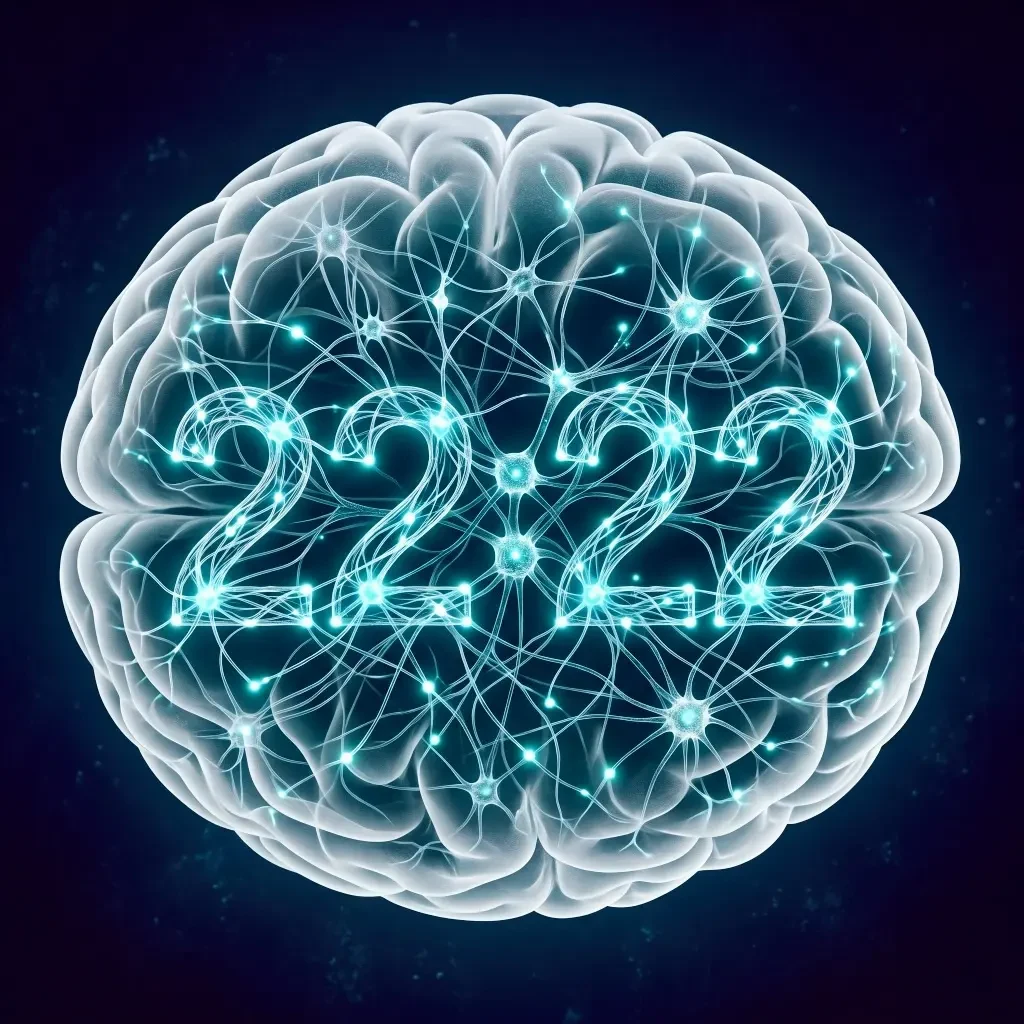
22:22 Explained by Psychology & Neuroscience
SyncNumbers Research
Cognitive Pattern & Synchronicity Studies
When you start asking “what does science actually say about 22:22?”
You just looked at the clock. And it said 22:22. Again. Not the first time this week. Maybe not even the first time today. At first you’d just smile, maybe screenshot it for a friend. But something has changed: every time 22:22 appears, alongside the small jolt of surprise, a more rational curiosity lights up. “Okay, the symbolism is nice… but what is actually happening in my head when I keep noticing this hour?”
Maybe you’re coming from a period when angel numbers kept you company: 11:11, 22:22, 3:33. They gave you comfort, they felt like gentle messages in difficult moments. Now, however, you feel the need to integrate that part with another, equally important: the part that reads psychology books, listens to neuroscience podcasts, gets excited when someone clearly explains how the brain works. You don’t want to choose anymore between “magic” and “science.” You want to understand how they speak to each other.
Maybe you’ve caught yourself flipping between a spiritual reel about 22:22 and an explainer video about RAS and cognitive biases, sensing that both narratives are telling you something true. When you see 22:22 in a meaningful moment of your life, you feel moved; when someone explains Frequency Illusion and Confirmation Bias, you recognize yourself in the dynamics described. And you wonder: “How do I put it all together without reducing, without ridiculing, without becoming dogmatic in either direction?”
If you’re here, you probably don’t want someone to tell you “stop believing, it’s just a coincidence,” nor someone who promises that 22:22 is the secret key to your destiny. You want a guide that treats you as an adult: capable of being amazed by a synchronicity, and at the same time capable of appreciating the beauty of a well-made neuroscience explanation. You want to understand why your brain hooks onto this hour, and how you can use this awareness to know yourself better, not to scold yourself for “falling for it.”
The Gist: 22:22 is an ideal case to see the meeting between symbols and brain in action. On one side, numerology, angelic tradition and Jungian synchronicity link it to balance, cooperation and concrete construction. On the other, psychology and neuroscience show how the Reticular Activating System, the Frequency Illusion (Arnold Zwicky, 2005) and Confirmation Bias lead you to notice and remember this exact hour in emotionally charged moments. It’s not just “magic,” nor just “chance”: it’s how the mind selects and colors a numerical pattern that resonates with your moment in life. The key is to use 22:22 as a mirror of your cognitive processes and inner world, not as an oracle that decides for you.
Deep Symbolic Analysis
To understand what psychology and neuroscience add to the picture, it helps to first look at 22:22 with the eyes of the symbol. In numerology, the number 2 is tied to relationship, to the duality that seeks harmony: me and the other, inside and outside, thought and action. It’s the opposite of the heroic loneliness of 1: the 2 speaks of cooperation, sensitivity, listening, partnership. When the 2 doubles into 22, you enter the territory of master numbers: energies perceived as more intense, often connected to large projects or a particular vocation.
The 22 is often called “Master Builder,” meaning the one who doesn’t just imagine but translates into form. Having a brilliant idea is one thing; turning it into a bridge, a company, a coherent life path is another. The 22, symbolically, holds vision and concreteness together. If you bring this gaze to 22:22 — four lined-up twos — it’s as if life were showing you a snapshot of balance in action: relationship, cooperation, construction and responsibility, repeated until you catch the theme.
The theosophical reduction (2+2+2+2 = 8) adds a further layer: 8, often tied to karma, cycles, energetic exchange, the balance between giving and receiving. It’s the number of “the bill that comes due”: emotionally, relationally, materially. Seen in this light, 22:22 can feel like a checkpoint: a moment in which, even without realizing, you’re taking stock. As if the mirror hour stopped you for a second and asked: “How are you using your energy? Are you building something that resembles you?”
In angelic-number language, 22:22 is often interpreted as a message of support in building your path: “you’re supported in realizing what’s truly aligned with you,” “keep taking small steps toward what feels right,” “look for balance between what you dream and what you do every day.” It isn’t so much the number of dramatic turning points, but the one of coherent choices, of micro-decisions that, over time, define a trajectory.
Looked at through Jung’s lens, 22:22 can be read as a point of intersection between inner and outer worlds: the “neutral” event of a time aligning into four twos becomes meaningful when it touches an active archetype in you. The Builder who wants to create something of their own, the Just who seeks balance, the Collaborator who wants healthy relationships. Synchronicity emerges when, in a moment when these themes are alive, you bump into a symbol that embodies them. It isn’t the symbol that creates the theme: it’s the theme that finds in that symbol a good container.
Compared to the pillar on the complete guide to the meaning of 22:22, what interests us here is mainly this: 22:22 as a numerical “form” the mind can use to represent deep questions about balance, cooperation, construction of one’s life. It’s on this base that psychology and neuroscience come into play, not to deny, but to show how the brain participates in this symbolic process.
The Psychological Explanation
Let’s step into the mind’s control room. What happens, at the brain level, when you feel like you see 22:22 “everywhere” and you become convinced it can’t be just chance? Three key concepts help to understand it: Reticular Activating System, Frequency Illusion, and Confirmation Bias.
The Reticular Activating System (RAS) is a network of neurons in the brainstem with a fundamental function: filtering stimuli. Every second, your brain receives more information than it can consciously process: noises, colors, words, numbers, internal sensations, thoughts. The RAS decides what to “let through” to attention based on what is relevant for you in that moment: your fears, your desires, your goals. If you’re questioning yourself a lot about your life, your relationships, your career, and 22:22 has entered your orbit as a symbol of balance, the RAS will start highlighting it.
The Frequency Illusion — Baader-Meinhof phenomenon — describes exactly that moment when something you used to ignore suddenly seems to appear everywhere. Arnold Zwicky coined the term “frequency illusion” in 2005 precisely to explain this: it’s not that the object in question (a number, a word, a car model) has become more frequent — it’s that you’ve changed your filter. Every time the clock shows 22:22 and you notice it, the event gets “marked” by your mind as worth remembering, especially if it comes with an emotion (surprise, comfort, fear).
Confirmation Bias completes the picture. It’s the tendency to seek out and remember mostly the information that confirms what you already think or hope. If you’ve started believing 22:22 is a message, or a “sign you’re on the right path,” every time you see it in coincidence with something meaningful will become evidence in favor. The times when 22:22 appears and you don’t look, or when you check the clock and it shows any other hour, will go unnoticed. The mind builds a coherent story: “I always see it in important moments,” even though, statistically, that perception is the result of a very rigid selection of data.
All this isn’t meant to say “you’re inventing the synchronicities.” It’s meant to show you that you are an active part of the process. You’re not a passive receiver onto whom numbers imprint themselves; you’re also the algorithm that decides which numbers stay in memory and which don’t. If, in a certain period, 22:22 seems to resonate deeply with the kind of questions you’re asking yourself, your mind will do everything to notice, connect, and remember it.
Jung would say synchronicity sits exactly here: in the point where an outer coincidence meets an active inner content. Cognitive psychology explains how the meeting happens at the level of filters and biases. Neuroscience, in turn, reminds you that the very structure of the brain is oriented to seek patterns, find stories, and prefer “something that means” over “nothing to see.” Knowing this doesn’t take poetry away from 22:22; it gives you back the responsibility for what you do with that poetry.
Practical Actions
First step: observe 22:22 as an experiment, not only as a message. The next time you see it, instead of immediately asking “what does it want to tell me?”, bring attention to what your mind was doing a moment before. What were you thinking about? Was it a repetitive thought, a worry, a desire, a memory? You can mark these observations in a notebook or an app. After some weeks, you’ll have material to see not only every appearance of the hour, but the type of inner content that precedes it. It’s a simple, powerful way to surface cognitive and emotional patterns that would otherwise stay vague.
Second step: train your eye on biases, gently. When you find yourself saying “I always see it” or “it can’t be a coincidence,” play a little mental game: deliberately recall three recent situations in which you looked at the clock and it wasn’t 22:22, or in which something important happened without any double hour appearing. It’s not about dismantling synchronicity, but about rebalancing perception, reminding the brain that the story it’s building is one of many possible. This trains the ability to also see the data Confirmation Bias would tend to discard.
Third step: integrate 22:22 into your self-listening practices. If this hour has a strong symbolic value for you, you don’t need to switch it off. You can, however, choose consciously how to use it. For example, you can decide that every time you encounter it you’ll grant yourself a “micro ritual” of awareness: three minutes of journaling on what worries you and what you desire, a brief body-focused meditation, a guiding question (“what does this pattern I’m seeing outside tell me about what I’m living inside?”). Or you can use 22:22 as a reminder to revisit, every once in a while, the complete guide to the meaning of 22:22 with new eyes, asking which parts truly resonate with your experience in light of what you now know about your own mental mechanisms. This way intellectual curiosity and the need for meaning work together, instead of fighting each other.
Related Articles
The information published on SyncNumbers is for informational, cultural, and personal reflection purposes only. It does not constitute professional, medical, or psychological advice.