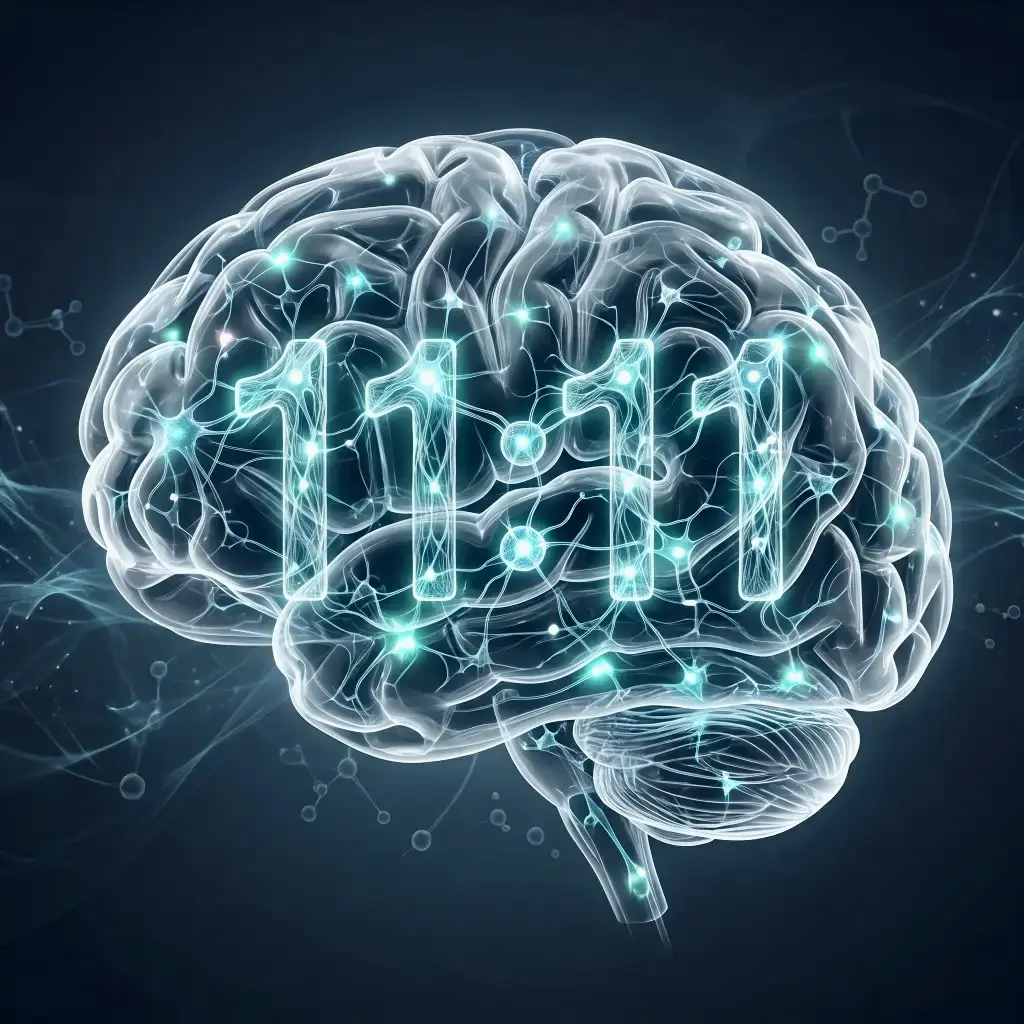
11:11 Explained by Psychology & Neuroscience
SyncNumbers Research
Cognitive Pattern & Synchronicity Studies
When you start asking “what does science really say about 11:11?”
You just looked at the clock. And it said 11:11. Again. It’s not the first time this week. Maybe not the first time today. And each time, beyond that little jolt of wonder, another voice now lights up inside you: “Ok, the symbolism is nice… but what’s actually happening in my brain? Is it just a coincidence or is there something subtler, explainable in psychological and neuroscientific terms?”
Maybe you went through a phase where 11:11 felt like a message from above, a romantic or spiritual sign. Now, though, you realize your curiosity has changed: the answer “it’s the universe talking to you” is no longer enough. You want to understand how attention works, how synchronicities form from the mind’s perspective, why some numbers become magnetic and others don’t. You find yourself reading psychology articles, hearing about RAS, Frequency Illusion, Confirmation Bias, and wondering how all these things interweave with the almost poetic experience of seeing 11:11 “at the right moment.”
Maybe you recognize yourself in this scene: you’re on the couch, phone in hand, switching between a spiritual reel and a neuroscience explainer video without any issue, because you feel the two dimensions don’t exclude each other. Part of you loves the Jungian synchronicity idea, the other wants data, hypotheses, experiments. You’re curious to know that a linguist like Arnold Zwicky coined the term “frequency illusion” in 2005, and at the same time you’re struck by how well this illusion’s description applies to your experience with 11:11.
If you’re here, you probably aren’t so much afraid of “going crazy” as of staying on the surface. You want to move beyond both “it’s all just chance” and “everything is magical and predestined.” You want a map that holds both together: the beauty of feeling a number speaks to you and the rigor of understanding how the brain builds that feeling. And, underneath, there’s a very concrete question: “How can I use this awareness in my everyday life, without reducing everything to chemistry, but without blindly letting a time on the clock guide me either?”
This page is for those who look at 11:11 with intellectual curiosity, not just devotion. For those who’ve already perhaps browsed the complete guide to 11:11 meaning and now feel the need to enter the mind’s “engine room.” You won’t find a cynical debunk or a blind confirmation: you’ll find a bridge, built with symbols, synapses, and cognitive biases.
In Brief: 11:11 is an excellent example of how symbols and brain work together: on one side numerology, archetypes, and Jungian synchronicity; on the other Reticular Activating System, Frequency Illusion, and Confirmation Bias. It’s not just “magic” nor just “chance”: it’s the way the mind, especially during emotionally charged phases, selects and amplifies a pattern you’ve loaded with meaning. The key is to use this awareness to observe how you think, how you seek confirmations, what strikes you, and transform 11:11 from an external oracle into a mirror of your cognitive processes and inner world.
Deep Symbolic Analysis
To understand what psychology and neuroscience add to the 11:11 story, it’s worth first looking closely at what kind of symbol it is. In numerology, 11 is considered a master number: it represents intuition, inspiration, vision, the sensation of being on the edge of something broader than yourself. It’s a number that doesn’t speak of quiet stability, but of transition, spiritual “charge,” a window open to deeper levels of consciousness. When 11 doubles and appears as 11:11, this energy multiplies: four ones aligned, like columns forming a threshold.
If you look only at the numbers, there’s already an interesting story. The theosophic reduction of 1+1+1+1 leads to 4, which in many symbolic systems is the number of structure: the four cardinal points, the four elements, the four table legs holding up reality. In other words, 11:11 is a paradox: a number born from a “high,” intuitive vibration (the master 11), but that also carries the idea of concretization, grounding (the 4). For those who experience it as synchronicity, this tension often translates into a precise feeling: “I sense there’s something more, but I need to figure out how to bring it into reality.”
In the angelic tradition, 11:11 is often associated with an awakening message, as if saying: “Look more closely, there’s a bigger design.” Some readings connect it to specific guardian angels or archangels who invite trust, coherence with one’s path, and responsibility toward what feels true. If you think about it, this is already a language that approaches psychology: awakening, coherence, responsibility are concepts we find in therapy too, just framed in other terms.
From a Jungian standpoint, 11:11 lends itself well to being read as a “contact point” between unconscious and external world. Jung called synchronicity those meaningful coincidences where an event outside you seems to respond to an internal state, without causal explanation. If you’re in a moment of searching for meaning, or of important passage (relational, professional, existential), it’s understandable that a symbol like 11:11 becomes the place where this search concentrates: it’s simple, visual, repeatable, and above all it’s charged by a collective imagination that already assigns it a special aura.
What psychology and neuroscience add isn’t a denial of all this, but an additional question: why that symbol and not another? Why doesn’t 10:41 or 12:34 strike you with the same force? The answer, as we’ll see, has much to do with how the brain is structured to seek patterns, fill meaning gaps, and construct coherent narratives.
The Psychological Explanation
Let’s move into the brain’s “control room.” One of the keys to understanding why you notice 11:11 at certain moments is the Reticular Activating System (RAS), a set of brainstem structures that decides which information, among billions of stimuli, reaches your conscious attention. You can’t perceive everything: it would be unmanageable. The RAS works as a dynamic filter, updating based on what’s relevant to you in that period: fears, desires, goals, curiosities.
Imagine you’ve just discovered that 11:11 is considered a “special” number, or you’re going through an emotionally intense moment (falling in love, a crisis, an important decision) where that symbol enters your orbit. From that moment on, your RAS starts treating 11:11 as a potentially important signal. It’s not that the clock stops showing all other hours: it’s that, in the flow of digits, 11:11 gets highlighted. It’s a bit like buying a certain car model and then starting to see it everywhere: the world hasn’t changed — your filter has.
Here the Frequency Illusion comes in, also called the Baader-Meinhof phenomenon. Arnold Zwicky, a linguist, coined the expression “frequency illusion” in 2005 to describe precisely that feeling where something just noticed — a word, a symbol, a number — suddenly seems to appear everywhere. In the case of 11:11, the mechanism is almost textbook: once you’ve connected the double hour to a meaning (awakening, sign, synchronicity), your brain registers with much greater force the times the clock reads 11:11. The hundreds of times you glance at the display and find “anonymous” numbers fade to the background, erased from memory.
Reinforcing this distortion is Confirmation Bias, one of the most studied biases in cognitive psychology, clearly described by authors like Daniel Kahneman. We spontaneously tend to seek, notice, and remember mainly information that confirms what we already believe or hope. If you start from the idea that “11:11 is a sign I’m on the right path,” every time you see it during a positive moment becomes supporting evidence. If instead you fear that 11:11 heralds something negative, every anxious coincidence fits perfectly into your theory. Everything that doesn’t align with the story gets discarded — or never even registered.
Up to this point, you might think psychology is “dismantling” 11:11. In reality it’s doing something subtler: showing you the building blocks with which you construct your synchronicity experience. Jung didn’t deny the role of perception and biases at all: synchronicity is meaningful for you precisely because it concerns your inner contents, your story, your conflicts. What neuroscience adds is a detailed description of how the unconscious and the brain collaborate to make a numerical pattern so salient.
In this sense, 11:11 becomes a perfect case study for watching the mind at work in real time. You can observe yourself seeking patterns, reassuring or frightening yourself with coincidences, building stories that help — or sometimes trap — you. The number is no longer just something that “happens to you,” but a mirror of how you interpret the world. And this is one of the most powerful insights of contemporary psychology: we can’t control everything that happens to us, but we can become ever more aware of how we tell it to ourselves.
Practical Actions
First invitation: use 11:11 as a micro-experiment of applied psychology on yourself. Next time you notice it, instead of immediately asking “what does it mean?”, try asking “what was my brain doing a moment ago?” Were you thinking about something important, bored, anxious, inspired? You can jot it down in a notebook or an app. After a few weeks, rereading, you’ll start seeing patterns not just about the number, but about what becomes worthy of attention for you.
Second invitation: observe biases in real time. When you catch yourself telling the story “I see it everywhere,” try to consciously recall three or four times you looked at the clock and it wasn’t 11:11. Not to diminish the synchronicity, but to train the mind to also consider data that doesn’t confirm the dominant story. It’s a simple but powerful exercise to soften Confirmation Bias and remind yourself that your perception is a lens, not a neutral camera.
Related Articles
The information published on SyncNumbers is for informational, cultural, and personal reflection purposes only. It does not constitute professional, medical, or psychological advice.